

How To Draw Influence Lines For Trusses
>>When you're done reading this section, cheque your understanding with the interactive quiz at the bottom of the page.
The construction of influence lines for trusses is similar to the structure of influence lines for beams; however, equally mentioned previously, information technology is important to make up one's mind which path the moving load takes across the truss. An case truss for a route bridge is shown in Effigy 6.11. On this truss, the route surface is level with the lower chord of the truss. Therefore, an influence line for this truss would be constructed along a direct line that joins the pin at the left with the roller on the right along the lower chord of the truss.
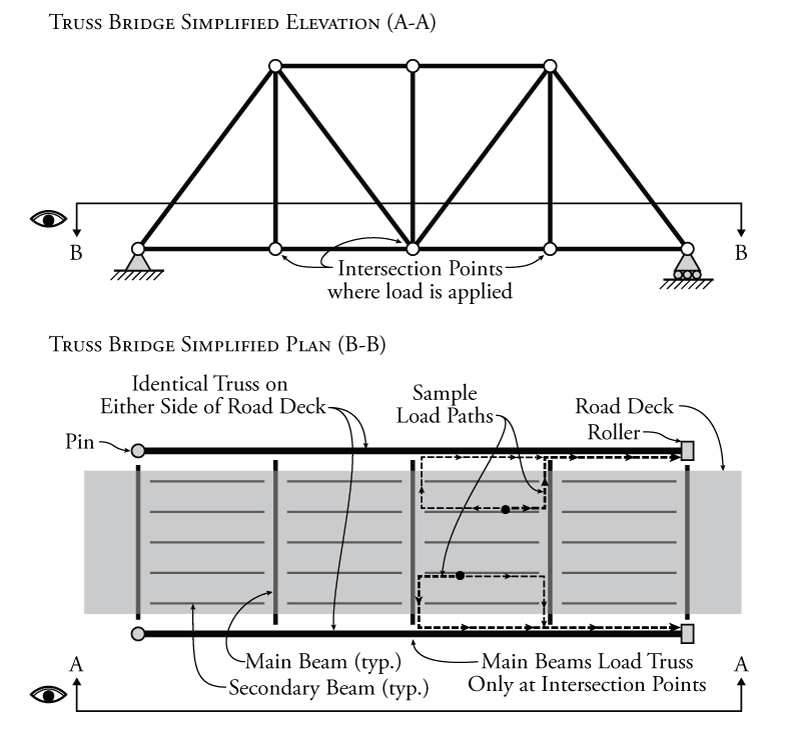
Figure half dozen.11: Truss Bridge Structure with Load Path
Another important difference for influence lines for trusses is that nosotros must presume that the load tin only be transferred to the truss at the intersection points between the members. This is necessary because the truss members themselves are often assumed in design to only take axial forces. Any loads betwixt the intersection points on the truss elements would cause them to bend. This is also how real trusses are often designed as shown in Effigy 6.11. In the figure, a typical only-supported truss bridge is shown at the top. Of course, for a bridge, you need to actually take two trusses, ane on either side of the roadway. This is shown in the plan at the bottom of the figure, where the route deck is shown by the grey shaded area and the trusses are on either side (top and bottom). These trusses are joined together by master beams that run between them at the locations of the intersection points between the truss members. These main beams are responsible for transmitting the load from the roadway to the truss intersection points. The chief beams are also often connected together by secondary beams. The road deck would so sit on top of the secondary beams. So, the load path for a load applied on any bespeak of the road deck must travel through the secondary beams to the closest main axle, and from at that place straight to an intersection point on the truss. The truss then transfers the primary beam loads from the intersection points to the supports at either end. Sample load paths are shown in Effigy six.11.
This ways that whatsoever load that is located between intersection points volition be divide between the ii closest intersection points (in proportion to how shut the load is to each intersection signal). This means that in between the intersection points, the values are just an interpolation between the ii closest points. For truss influence lines, the consequence of this is that nosotros can find the values for the influence line at the at intersection points, and and then but connect the points together using straight lines.
To find these influence lines, there is no easy Müller-Breslau principle. The method of joints or method of sections must be used to find a truss member force as a function of the moving unit load position. This also means that, like the equilibrium method for beams, you frequently must discover the influence diagrams for one or more reaction forces before you can discover the influence diagram for the internal axial force in a specific truss member.
Example
An case truss is shown in Figure 6.12. This truss supports a bridge and the deck of the bridge is concurrent with the bottom chord of the truss. So, the path for the moving unit signal load is along a line joining points A and D. The distance $x$ is the altitude of the moving load from betoken A. Find the influence lines for the three members EF, BF and BC.

Figure 6.12: Influence Lines for Trusses Example
To find those fellow member influence lines, nosotros first take to find the influence lines for the reactions at A and D (IL $A_y$ and IL $D_y$). Since we tin can use external equilibrium to find the reactions, the process of finding reaction influence lines for trusses is the same as it was for beams. For the influence on reaction at $D_y$ we tin utilise a moment equilibrium well-nigh point A:
\begin{align*} \curvearrowleft \sum M_A &= 0 \\ (-1.0)x + D_y(6) &= 0 \end{align*} \begin{equation*} \boxed{D_y = \frac{10}{vi}} \end{equation*}
And vertical equilibrium for the influence line for the reaction at point A:
\begin{align*} \uparrow \sum F_y &= 0 \\ A_y -i.0 + D_y &= 0 \\ A_y -one.0 + \frac{10}{6} &= 0 \end{align*} \brainstorm{equation*} \boxed{A_y = 1.0 - \frac{ten}{6}} \end{equation*}
These resulting influence lines are shown in Figure 6.13.
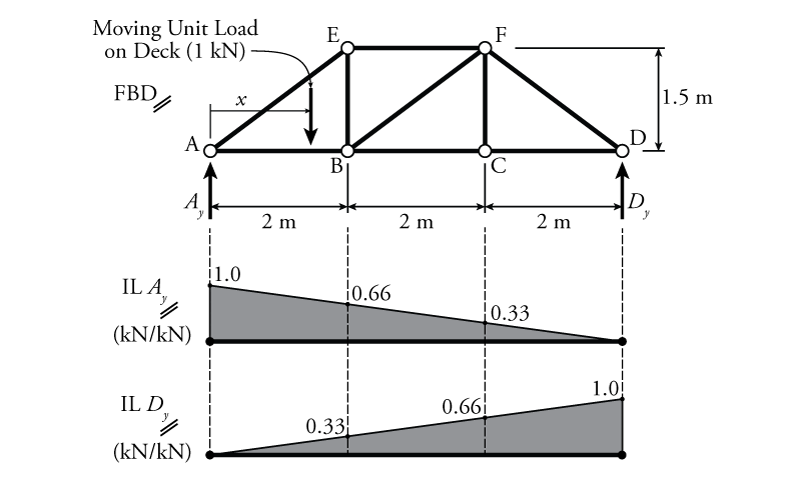
Figure 6.13: Influence Lines for Trusses Instance - Reaction Influence Lines
At present that we know the influence line expressions for the reactions, nosotros tin can use the method of sections to observe the influence diagrams for the internal axial forces in members EF, BF and BC. The free body diagrams for the left and right cuts to find those internal forces are shown at the top of Effigy 6.14; withal, the solution to this problem is more circuitous because there are three different possible locations for the moving signal load: on the left side of the cut between A and B, on the right side of the cutting betwixt C and D, and betwixt the two sides of the cut betwixt B and C. The point load being located in each of these different locations volition impact the equilibrium of the cut sections differently. Therefore, we have to consider all three cases for each influence diagram that nosotros want to construct.
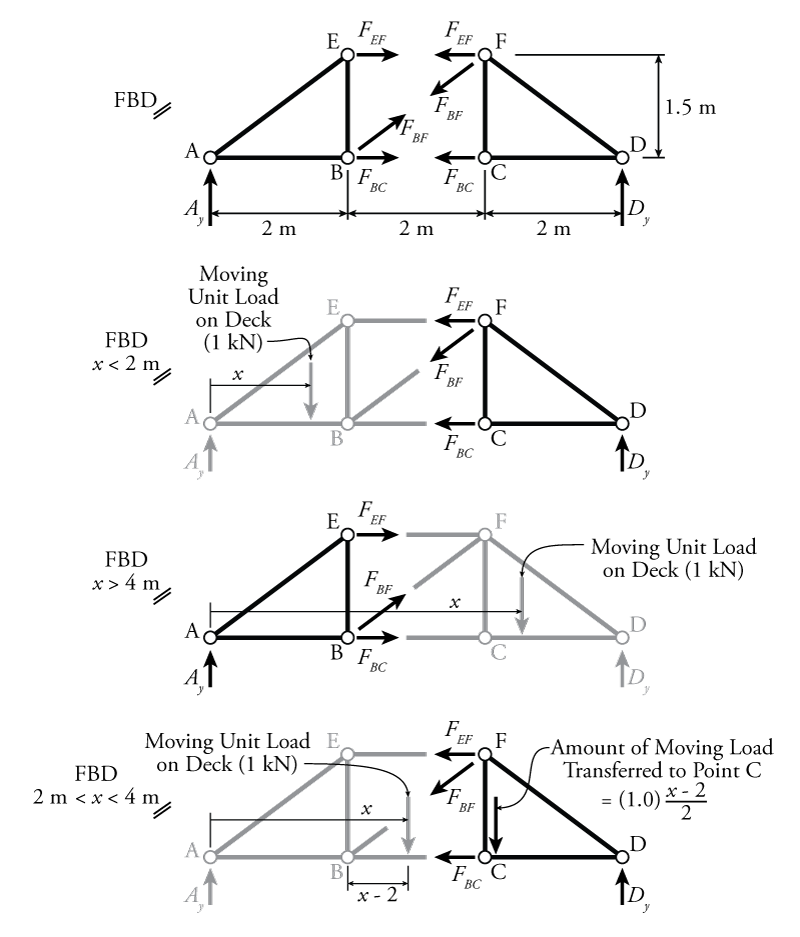
Figure vi.14: Influence Lines for Trusses Instance - Free Body Diagrams for Calculation of Internal Axial Force Influence Lines
Of grade, for the solution of any detail internal member centric force, we can use equilibrium on either side of the cut. Simply, to brand our lives easier, it is typically simpler to select whichever side of the cut does not have the moving unit betoken load on information technology. So, when the point load is located on the left side of the cutting betwixt A and B ($x<ii$), it simplifies the assay to find the forces in the cut members using the correct side department. Likewise, when the betoken load is located on the correct side ($x>4$), it makes sense to do the equilibrium calculations using the left side section. These two situations are shown in the middle two diagrams in Figure half dozen.14. When the moving point load is between the two cut sections (betwixt B and C, $2 < 10 < 4$), it doesn't matter which side cut section you apply because some portion of the load in between B and C volition be transferred to the closest intersection point as shown on the bottom diagram of Figure 6.14.
Allow'southward kickoff with the influence diagram for the axial force in member EF ($F_{EF}$). The first case we will consider is for when the moving point load is on the left section ($x<ii$). To solve for $F_{EF}$ we will use equilibrium on the correct section as shown in the second diagram from the top in Figure 6.fourteen. If we employ the right section, the moving indicate load itself will not come up into the equilibrium calculation as shown. To find $F_{EF}$ we tin use a moment equilibrium about indicate B. This is okay even though indicate B is not part of the section. Information technology is just a convenient point in space that is concurrent with forces $F_{BF}$ and $F_{BC}$ so that those ii forces volition not come into the moment equilibrium calculation.
\begin{align*} \curvearrowleft \sum M_B &= 0 \\ D_y(four) + F_{EF}(1.5) &= 0 \\ F_{EF} &= - \frac{viii}{3} D_y \stop{align*}
only nosotros know from our previous reaction influence line calculations that:
\brainstorm{align*} D_y &= \frac{x}{6} \\ \text{so, } F_{EF} &= - \frac{8}{3} \left( \frac{x}{6} \right) \end{align*} \begin{equation*} \boxed{F_{EF} = -\frac{4x}{9} \; \text{for} \; x < 2} \stop{equation*}
For the same force $F_{EF}$, when the unit indicate load is on the right section ($x>4$), we volition employ equilibrium on the left department as shown in the tertiary diagram from the top in Figure 6.14. Again, using moment equilibrium about point B:
\brainstorm{marshal*} \curvearrowleft \sum M_B &= 0 \\ -A_y(2) - F_{EF}(1.5) &= 0 \\ F_{EF} &= - \frac{4}{three} A_y \cease{align*}
but we know from our previous reaction influence line calculations that:
\begin{marshal*} A_y &= one.0 - \frac{x}{6} \\ \text{so, } F_{EF} &= - \frac{4}{3} \left( 1.0 - \frac{ten}{6} \right) \cease{align*} \begin{equation*} \boxed{F_{EF} = -\frac{four}{3}+\frac{2x}{9} \; \text{for} \; x > 4} \terminate{equation*}
When the moving unit load is in betwixt the ii sections ($2<x<4$), then some portion of the moving load will be transferred to the joint closest to the department. If we utilize the equilibrium on the right section (as shown in the lesser diagram of Figure 6.14), then the portion of the moving betoken load that is transferred to indicate C is dependent on how close the point load is to point C (relative to point B). In the figure, the distance between the moving point load and signal B is $x-two$. The respective resulting load on point C caused by the unit load is equal to:
\brainstorm{align*} (1.0) \frac{x-2}{2} \finish{align*}
So, when the point load gets to C ($x = 4$), and so the load on C will be equal to 1.0. When the load is at B ($10 = 2$) the load on C will equal 0. Including this transferred load in the equilibrium of the right side of the cut every bit shown in the lower diagram of Figure vi.14, nosotros can again use the moment equilibrium well-nigh point B:
\begin{align*} \curvearrowleft \sum M_B &= 0 \\ D_y(4) - (i.0) \frac{x-two}{ii} (ii) + F_{EF}(one.v) &= 0 \\ (1.5) F_{EF} &= \frac{x}{three} - 2 \end{align*} \begin{equation*} \boxed{F_{EF} = \frac{2x}{9} - \frac{four}{3} \; \text{for} \; 2 < x < four} \stop{equation*}
At this point nosotros have institute the value of the influence line for every potential location of the point load ($x<2$, $2<x<iv$, and $x>iv$). The resulting influence line is shown in Effigy 6.fifteen (IL $F_{EF}$). Nosotros can draw these easily by merely drawing the end point for each department and connecting the stop points with straight lines. For example, for the section $x<2$ nosotros can discover the $F_{EF}$ for $10 = 0$ and $x=2$ and join the area between the 2 points with a straight line.
Every bit discussed previously, the influence lines for determinate trusses consist of straight lines and that those lines are interpolations between the influence line values at the intersection points. Therefore, although we explicitly solved for all three potential ranges of $x$, we could have just solved only for the situations where the point load is on the left of the cutting and the right of the cut ($x<2$, and $x>4$). If we did that, and drew the influence lines for those portions, nosotros can notice the influence line for the department in between the cuts by simply drawing a straight line between the values at the edges of the cutting as shown in Figure 6.15. This saves the problem of having to consider the portion of the moving unit load in between the cutting sections that acts on the equilibrium section.
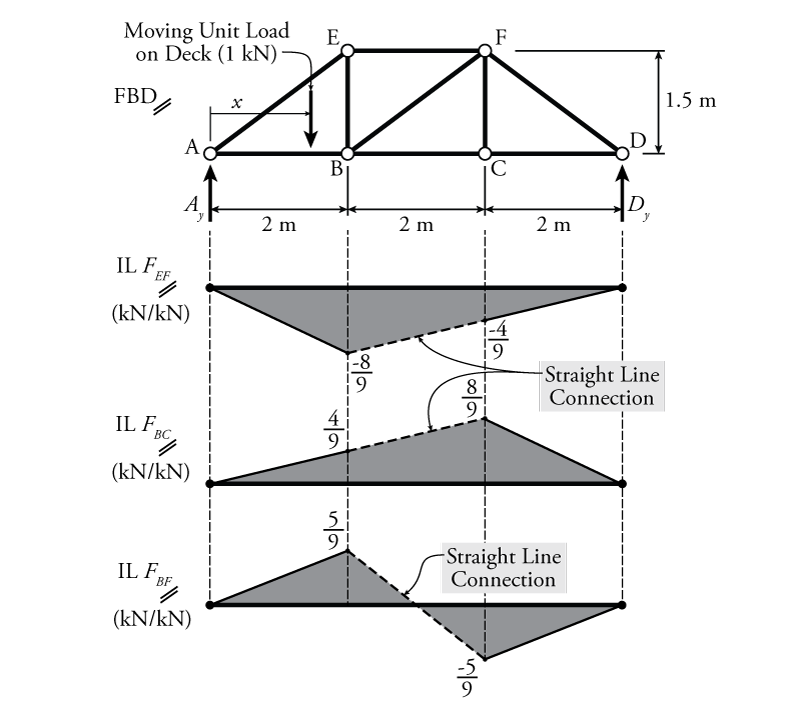
Figure 6.15: Influence Lines for Trusses Example - Internal Centric Forcefulness Influence Lines
Using the same method, we tin find influence lines for the other internal axial forces in members BC and BF. For member BC ($F_{BC}$), when $x<ii$, use the right side cutting section from Figure 6.fourteen and a moment equilibrium about signal F:
\begin{align*} \curvearrowleft \sum M_F &= 0 \\ D_y(ii) - F_{BC}(1.5) &= 0 \\ F_{BC} &= \frac{4}{3} D_y \end{align*} \begin{equation*} \boxed{F_{BC} = \frac{2x}{9} \; \text{for} \; x < 2} \end{equation*}
For fellow member BC ($F_{BC}$), when $x>4$, use the left side cutting section from Figure half dozen.fourteen and a moment equilibrium about point F:
\begin{marshal*} \curvearrowleft \sum M_F &= 0 \\ -A_y(4) + F_{BC}(1.5) &= 0 \\ F_{BC} &= \frac{8}{3} A_y \end{align*} \begin{equation*} \boxed{F_{BC} = \frac{viii}{3} - \frac{4x}{nine} \; \text{for} \; x > 4} \finish{equation*}
The resulting influence line for the axial force in fellow member BC (IL $F_{BC}$) is shown in Figure 6.15. This time, since we didn't discover the expression for the influence line between B and C explicitly, we can simply connect the influence diagrams for the left and correct sides using a straight line every bit shown in the figure.
Lastly, for the influence diagram of the force in member BF ($F_{BF}$), when $x<ii$, apply the right side cut section from Figure 6.14 and a vertical equilibrium:
\begin{marshal*} \uparrow \sum F_y &= 0 \\ D_y - F_{BF}\left( \frac{1.v}{ii.v} \right) &= 0 \\ F_{BF} &= \frac{v}{three} D_y \end{align*} \begin{equation*} \boxed{F_{BF} = \frac{5x}{xviii} \; \text{for} \; ten < two} \end{equation*}
For member BF ($F_{BF}$), when $x>4$, use the left side cut section from Figure 6.14 and vertical equilibrium:
\brainstorm{align*} \uparrow \sum F_y &= 0 \\ A_y + F_{BF}\left( \frac{1.5}{2.5} \correct) &= 0 \\ F_{BF} &= -\frac{five}{3} A_y \terminate{align*} \begin{equation*} \boxed{F_{BF} = \frac{5x}{xviii} - \frac{5}{three} \; \text{for} \; x > 4} \end{equation*}
Again, the resulting influence line for the axial forcefulness in fellow member BF (IL $F_{BF}$) is shown in Figure 6.15, and nosotros can just connect the influence diagrams for the left and right sides using a straight line as shown in the figure.

Source: https://learnaboutstructures.com/Influence-Lines-for-Trusses
Posted by: robinsonsciespoins.blogspot.com
0 Response to "How To Draw Influence Lines For Trusses"
Post a Comment