

How To Draw A Filled Triangle In Java
Programming Assignment Checklist: Recursive Graphics
What preparation do I need before beginning this assignment? Read Sections 2.i–two.3 of the textbook.
What is the layout of the initial equilateral triangle? By using the definition in the assignment and the Pythagorean theorem, you can evidence that the elevation vertex lies at (ane/ii, √3/2). Nosotros illustrate the coordinates of the initial iterations below to help y'all double-check.
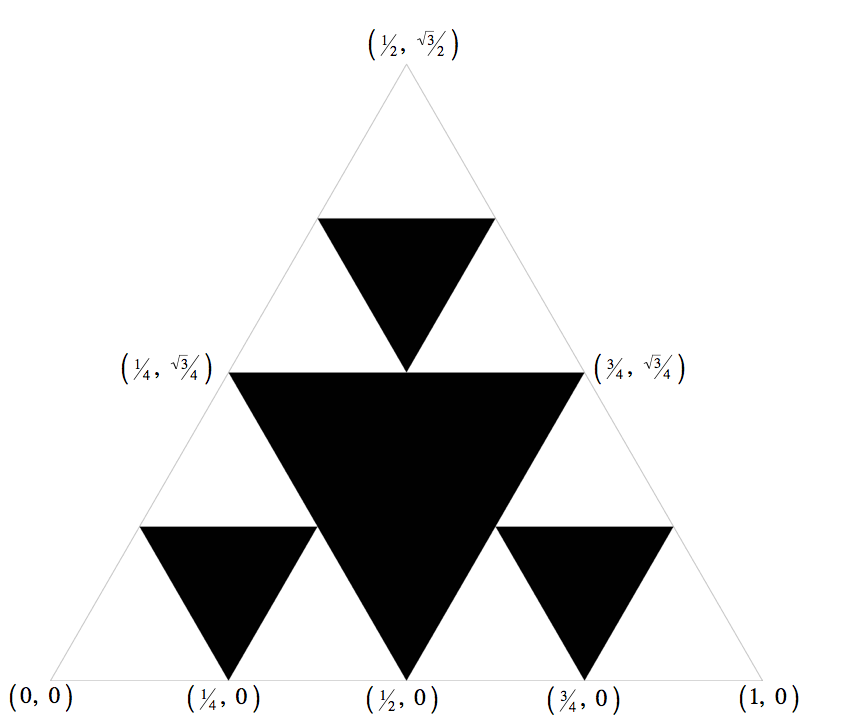
How do I draw a filled equilateral triangle? Employ StdDraw.filledPolygon() with appropriate parameters.
May I use a unlike color from black to fill in the triangles? Yes, you may apply any color that contrasts with the white background.
How can I create colors that aren't predefined in standard drawing? It requires using objects that we'll learn about in Affiliate 3. In the meantime, you tin use this color guide.
How should I go well-nigh doing the artistic part of the assignment? This function is meant to be fun, but here are some guidelines in case you're not so artistic. A very adept arroyo is to first choose a cocky-referential design as a target output. Check out the graphics exercises in Department ii.three. Here are some of our favorite pupil submissions from Spring '12. Meet also the Famous Fractals in Fractals Unleashed for some ideas. Here is a listing of fractals, past Hausdorff dimension. Some pictures are harder to generate than others (and some require trig); consult a preceptor for advice if you're unsure.
What will crusade me to lose points on the artistic part? We consider three things: the structure of the lawmaking; the construction of the recursive call tree; and the art itself.
For example, the Quadricross looks very unlike from the in-grade examples, but the code to generate it looks extremely similar to HTree, and so information technology is a bad pick. On the other paw, fifty-fifty though the Sierpinski Curve eventually generates something that looks identical to the Sierpinski Triangle, the code is very unlike (probably including an "angle" argument in the recursive method) and then it would earn full marks.
Possible ideas include: not having the same number of recursive calls per level or having not all recursive branches terminate at the same depth; not using "level" or using "level" for a secondary purpose; mutual recursion; interesting overlapping effects based on changes to your code; interesting shapes using new API methods. Dissimilarity this with the examples Htree, Sierpinski, and NestedCircles which take very similar structures to one another.
You volition also lose points if your artwork can be created just every bit easily without recursion (like Factorial for instance). If the recursive call tree for your method is a straight line, it probably falls under this category.
May I use .gif, .jpg, or .png in my artistic creation? Yeah. If so, be certain to submit them along with your other files. Arrive clear in your readme.txt what role of the pattern is yours and what function is borrowed from the image file.
My function for Fine art.java takes several parameters, but the assignment says that I can but read in i command-line statement N. What should I do? Choose a few of the all-time parameter values and do something similar the following:
if (Due north == 1) { 10 = 0.55; y = 0.75; n = 3; } else if (N == 2) { x = 0.55; y = 0.75; n = 5; } else if (N == iii) { x = 0.32; y = 0.71; n = 8; } else if ... These are purely suggestions for how y'all might brand progress. You practise not take to follow these steps. Notation that your final Sierpinski.java program should not be very long (no longer than Htree, non including comments and blank lines).
- Review Htree.java from the textbook and lecture.
- Write a (nonrecursive) function filledTriangle() that takes three real-valued arguments (x, y, and size), and draws a filled equilateral triangle (pointed downwardly) with bottom vertex at (x, y) and side length size. To debug and test your function, write main() and so that it calls filledTriangle() a few times, with dissimilar parameters. You will be able to use this function without modification in Sierpinski.coffee.
- Write a recursive function sierpinski() that takes 4 arguments (north, 10, y, and size) and plots a Sierpinski triangle of society north, whose largest triangle has side length size and lesser vertex (x, y).
- Write a recursive function sierpinski() that takes one argument due north, prints the value n, and and then calls itself three times with the value due north-one. The recursion should finish when n becomes 0. To test this office out, write main() and so that it reads i integer N from the command line and calls sierpinski(N). Excepting the spacing, you should get the following output when you call sierpinski() with Due north ranging from 0 to 5. Brand sure you understand how this function works, and why information technology prints the numbers in the society it does.
- Modify sierpinski() so that in improver to printing n, it also prints the size of the triangle to be plotted. Your function should now have ii arguments: n and size. The initial telephone call from primary() should be to sierpinski(N, 0.5) since the largest triangle has side length 0.5. Each successive level of recursion halves the length. Your function should produce the following output.
- Alter sierpinski() so that it takes 4 arguments (n, x, y, and size) and plots a Sierpinski triangle of order n, whose largest triangle has side length size and bottom vertex (ten, y). First by drawing Sierpinski triangles with pencil and paper. Apply the picture in the Q+A above to figure out the geometry of where the smaller Sierpinski triangles should go.
- Remove all print statements earlier submitting.
- Your Art.java programme must take exactly one integer command-line argument N (which will exist between ane and 7).
- Don't call StdDraw.save(), StdDraw.setCanvasSize(), or StdDraw.setXscale() (or Y). These interfere with grading. (All the same, setting the scale in Art.java is okay.)
- Be sure to include a comment just above each method definition explaining what the method does — this will be required in all future assignments also. Leaving a comment for main is not required since the header already does basically the same matter.
- Go on to follow the guidelines from previous weeks.
Consider using our StdDraw3D library instead of StdDraw to create a three-dimensional fractal blueprint! (Note: This is not for actress credit nor for submission.) You can find documentation on the booksite.
To check that y'all accept downloaded StdDraw3D when running the installer, go to the command prompt and blazon:
java StdDraw3D
- Hither'southward a fractal in polymer clay, a fractal cookie, a fractal pizza, a fractal hamantaschen, and puff pastry.

Source: https://www.cs.princeton.edu/courses/archive/spring14/cos126/checklist/sierpinski.html
Posted by: robinsonsciespoins.blogspot.com
0 Response to "How To Draw A Filled Triangle In Java"
Post a Comment